

The short answer
For most hospitality groups, a managed platform wins on speed and pre-built integrations. That holds when you don't have internal BI resource. A bespoke build suits groups who want something shaped entirely around their own systems and roadmap.
Tortilla chose managed. Pho chose bespoke. Both groups solved the same Monday-morning problem. Here's how they decided, what they got, and how to work out which fits you.
The Monday morning problem every hospitality CFO knows
Wayne Dejager, CFO at Pho, said it plainly on a panel at Hospitality Tech360: "I wake up on a Monday morning. The first thing I would look at is last week's sales."
Then comes the flash report. Sales, labour, cost of goods, all the way down the P&L. Then the investor questions, two seconds later. Why is this. Why is that. What happened there.
If that information lives in spreadsheets pulled from Zonal, Harri, Deliveroo and a CRM, something breaks. Wayne put it like this: "I'm a CFO, so I don't do spreadsheet errors. I'd be lying. They break all the time. Doesn't matter how good you are."
Andrew Brook, Technology Director at Tortilla, walked into the same problem when he joined three years ago. "Spreadsheets built upon spreadsheets sending out with errors in. There was no trust in the data at all."
Wayne and Andrew both used the same word. Trust. That's what was broken. It wasn't a data shortage, because there was plenty of data. Nobody believed it.
What "managed" and "bespoke" hospitality data platforms actually mean
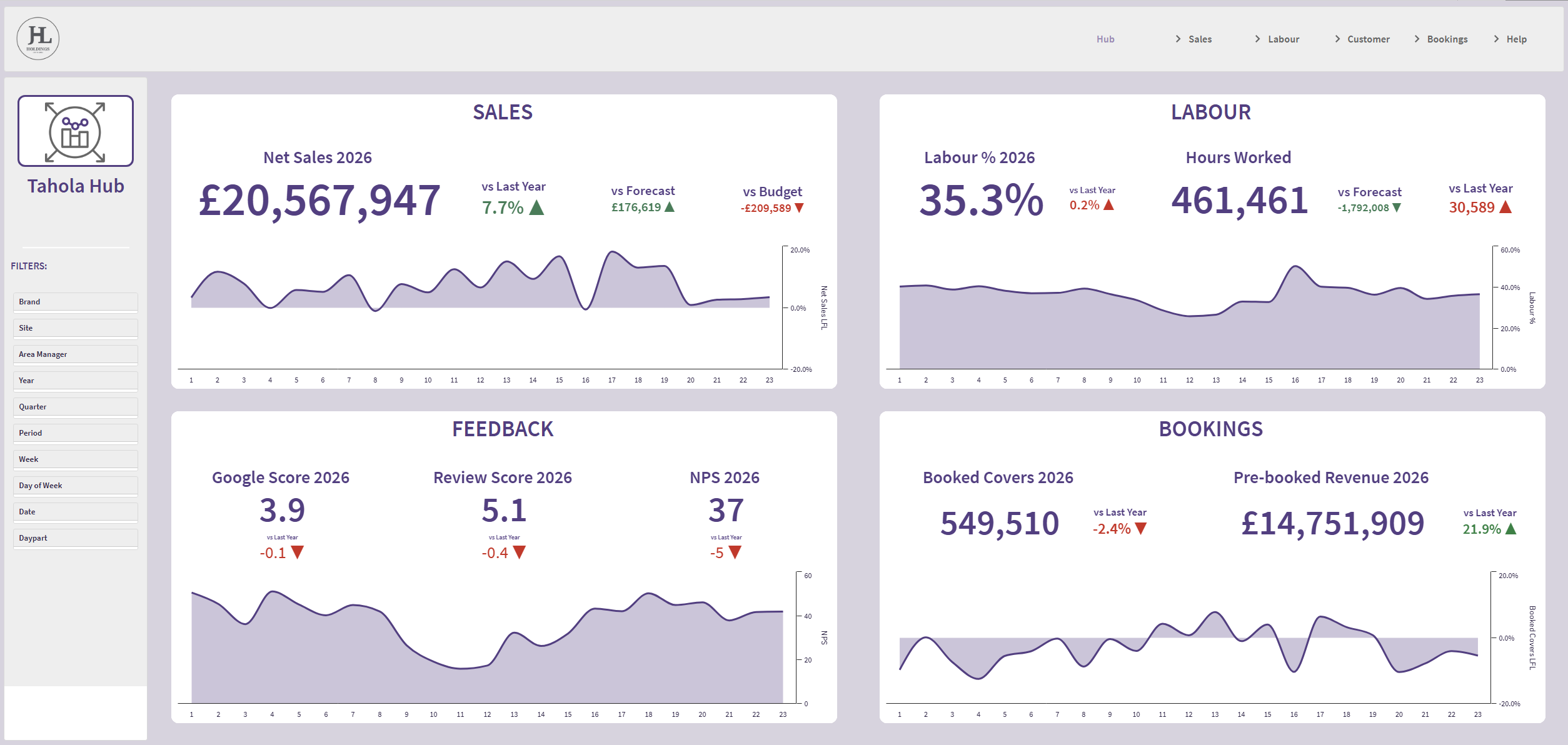
A managed platform is a subscription product. The vendor owns the data warehouse, the integrations to systems like Uber, Deliveroo and your EPOS, the dashboards, and the upkeep. You pay monthly and get value in weeks. Tahola AI is one example.
A bespoke build is a data warehouse and analytics stack built specifically for your business. You own the warehouse, the data model, the front end, and the roadmap. It takes longer to stand up, but you control every layer. Read more about our bespoke hospitality solutions here.
Two different routes to the same destination.
Route one: how Tortilla chose a managed data platform
Andrew joined Tortilla three years ago. 65 UK restaurants, 13 in France, no BI analyst and no budget for one. His finance team lost hours every week to manual reporting that nobody trusted anyway.
He called us in his first few weeks, and the reasoning was direct. He needed a platform he could hand to a partner, with integrations already built, and value visible to the board fast. "It was imperative for me that I could have the platform in the hands of a partner that I could trust," Andrew said.
The other big draw was shared integrations. If Tahola AI builds an Uber connector for one customer, every other customer gets it too. And if another customer has already built something Tortilla needs, Andrew isn't paying to build it twice.
What he got was the basics done properly: automated daily sales, weekly labour, margin packs. His finance team stopped building spreadsheets and started analysing what was in them. In Andrew's words: "It's changed things from an administrative task to a value-add info task."
The kiosk rollout that data made possible
Then came the test. Tortilla wanted to trial self-service kiosks, and the board was hesitant. Tortilla's guest journey is unusual, and there was real doubt kiosks would work.
Andrew used the data daily to show what was actually happening. Revenue. Mix. Customers buying things Tortilla didn't know they wanted.
The original plan was 20 kiosk sites in year one. They hit 50 sites live across the UK in 12 months. As Andrew put it: "Having that data instantly available to put in front of our CEO and the board, it was: how quick can we go with this?"
He's now layered Claude directly on top of the warehouse. Tortilla's founder and CEO opens it in the morning and asks questions about the business in plain English. "It's not going to be so much about dashboards," Andrew said. "It's going to be more in that kind of interactive information-now approach."
Route two: how Pho chose a bespoke restaurant data warehouse
Pho is a 50-site Vietnamese street food group with a serious delivery channel and worldwide ambitions. Wayne joined three years ago, into a full-stack change programme. New workforce management, new EPOS front end, new accounting system, new stock management, all moving at once. The BI decision sat in the middle of it.
Wayne looked at Power BI. He looked at the analytics bundled inside individual systems like Harri. They worked, but every option tied Pho to someone else's roadmap, colour scheme and data model.
He chose differently. "We wanted to own that data," he said. "We don't want to be dependent on anyone over the long term."
Here's what that looks like in practice. We built Pho a bespoke data warehouse, with Qlik on top, plus Qalyptus for spreadsheet-style automated reporting. Data flows in from Zonal, Harri, Deliveroo, Klaviyo and sentiment sources, and Qlik dashboards sit in the hands of every restaurant manager, not just head office.
The average spend per head insight that moved the needle
The early wins came from putting Qlik in operators' hands, and average spend per head was the standout. Some servers consistently upsell, most don't. Before the dashboard, nobody knew who was doing what, or why.
Wayne explained the move: "If I said to you, John over here, he's absolutely brilliant at selling. His ratio of extra sales per cover is really high consistently. Whereas Simon over here, not so good."
Once Pho could see it, they could map the top performers' habits into the training programme, group-wide. That insight is now feeding the training rollout. Wayne's next move is an AI layer he's already named. "We're a restaurant called Pho, so clearly our AI tool has to be called a Pho-bot."
The questions you didn't know to ask
This is the bit most operators underestimate. When data is locked in silos, you lose more than reporting speed. You lose the ability to ask questions that would never occur to you.
A story from my last role makes the point. We were sat in a meeting and stumbled on something nobody had spotted: 40% of the company's olive sales were going through one server in one site. Olives weren't strategic. They sat in the fridge, and most teams forgot they were on the menu.
That insight wasn't going to move the P&L on its own, but the principle behind it was huge. What was that one person doing? Could we teach it? Could we apply the same logic to higher-margin items? We never would have asked the question without all the data in one place, because we didn't know there was a question to ask.
Tortilla saw the same effect with kiosk purchase mix. Pho saw it with average spend per head. The common thread is that when data is joined up and trusted, the business starts spotting things it couldn't have asked for.
I've sat in menu development meetings where decisions were made on what someone in the room happened to like, or "the way we've always done it." Once the data is joined up, those conversations change. You're deciding from margin, mix and labour impact, not from preference.
.png?width=2547&height=1113&name=image%20(2).png)
How to choose between a managed and bespoke hospitality data platform
Trying to work out which route fits your group? Here are four honest questions.
Do you have internal BI capacity, or budget to hire it?
If no, managed is almost always the right call. The platform plus partner replaces a team you don't have.
How important is vendor independence?
If you've been locked into something painful before, that pain is real and bespoke removes it. If you haven't, you may be overweighting the risk.
How fast does the board want to see value?
Managed gives you working reports in weeks, and bespoke can take longer. Both are valid, and it depends what you've promised, and to whom.
How stable is your tech estate?
If your EPOS, workforce and finance systems are settled, a bespoke build compounds for years. If you're mid-change like Pho was, the answer is more nuanced.
If you genuinely can't tell which route fits, that's the conversation to have with someone who delivers both. (We do. Book a strategy call.)
Where AI fits in either hospitality data model
Twelve months ago, "AI in hospitality" mostly meant kiosks, headsets and forecasting models buried inside individual systems. That's shifted.
Today, Tortilla and Pho are doing the same thing in two different stacks. They put an LLM on top of a clean warehouse so business users can ask questions in plain English. Tortilla has Claude live, and Pho is building Pho-bot.
This is the bit that matters: AI only works if the layers underneath are solid. An LLM querying a warehouse full of conflicting definitions will confidently give you conflicting answers, and the trust you've built collapses faster than it formed. Get automation right, then insight, then bring AI in. In that order.
Hospitality data platform FAQ
What does a managed hospitality data platform include?
A platform like Tahola AI includes the data warehouse, pre-built integrations to common hospitality systems (EPOS, workforce, delivery, CRM), automated reporting, dashboards, ongoing maintenance, and a partner team that runs it. You bring your data and your questions.
What's involved in a bespoke restaurant data warehouse build?
A custom-designed data warehouse, integrations built for your specific stack, an analytics front end (typically Qlik or Power BI), and often a finance reporting layer like Qalyptus. You own all of it. Ometis builds and supports it for you.
Where does AI sit in either model?
On top of the warehouse, in both cases. Tortilla runs Claude against the Tahola AI warehouse, and Pho is building Pho-bot against their bespoke warehouse. The model layer is increasingly portable, and the warehouse underneath is what matters.
What if we already have Power BI and it's just not working well?
That's a different question, and often the right starting point. A data platform audit will tell you whether the issue is the tool, the data underneath, or the way it's been built. We do audits independently of which platform you end up on.
Do you only do Qlik?
No. We're the UK's largest dedicated Qlik consultancy and we lead with Qlik when it fits, but we work across Power BI, Tableau, Sigma, Snowflake, Databricks, Microsoft Fabric, and more. If Qlik isn't right for you, we'll say so.
Which UK restaurant groups have done this?
We've worked with more than 250 customers including Tortilla, Pho, Pizza Express, GDK, Burger King, Popeyes, Butlins and Toca Social. See our case studies.
The honest bottom line
Tortilla took the managed road and Pho took the bespoke road. Both groups now have data their boards trust and operators use, plus an AI layer either live or in build.
Here's the mistake operators make: they wait for a perfect answer to the managed-versus-bespoke question before doing anything. The data is already in your systems, and the decisions are already being made without it. The longer you wait, the more Monday mornings get lost.
Next steps
Book a strategy call for our hospitality team to look at your tech stack, goals, and challenges. We deliver both managed and bespoke, so the advice depends on your set up.
Not ready for a call? Read more about our hospitality data analytics services or our data platform audit.

Comments